
If you ever plan on using microphones on your drum kit, the overhead mics will be the most important thing along with a kick drum mic. The overhead mics pickup the overall sound of your kit, giving the listener a complete sound to hear.
Every other mic that you add afterward just adds some depth to the tunes.
With that being said, it’s important that you have a great pair of overheads that will bring out an authentic sound from your drums. Let’s look through some of the best ones on the market.
7 Best Overhead Drum Mics
1. Rode M5
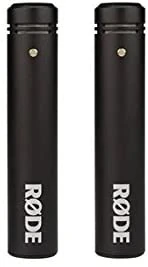
The Rode M5s are small-diaphragm cardioid condenser mics that work wonders as overheads. They’re great for stereo recording and bringing out a natural sound from most drum kit setups.
They’re smooth and predictable, having a a full and flat frequency response that makes mixing the drums a relatively easy task. Small diaphragm condensers often have boxy mids and exaggerated high-end colorations.
These M5 mics do a great job of cutting down on the boxy mids and exaggerated highs. The overall sound is very clean and articulate, especially in the cymbals and higher-tuned toms and snare drums.
The lower range isn’t muddy and adding the right amount of compression will really bring the toms to life.
There is no roll off pad, meaning you get the exact sound that you played and nothing more. Unfortunately, the matched pair of mics don’t come with carry bags, meaning you’d need to buy those separately if you plan on traveling.
Their price is very affordable, making them a decent entry-level set of microphones.
I have to commend Rode on the 10-year warranty they provide with these mics. It shows you that they’re durable and the company backs the product. I don’t know too many other drum companies that provide such a lengthy warranty.
My favorite thing about the mics is that they don’t emit much noise. That’s pretty uncommon for microphones at this price, so it makes them a lot more valuable in my opinion. Although they don’t have much self-noise, they’re still very sensitive and will pick up all of the subtleties in your drumming.
PROS
CONS
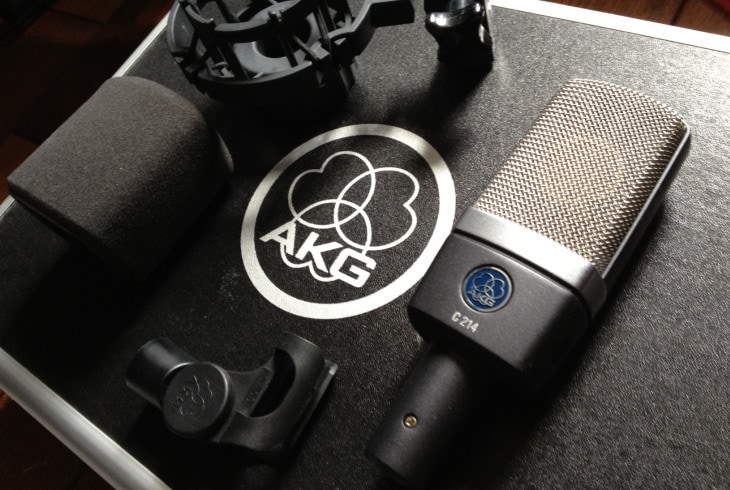
2. AKG C 214
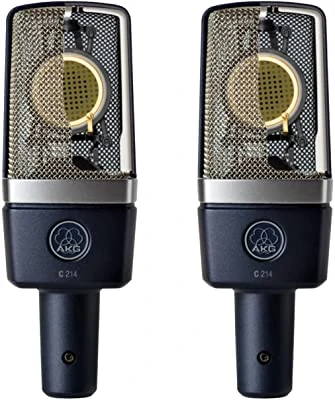
Moving from entry-level straight to professional quality, the AKG C 214 mics are large diaphragm condensers with a cardioid pattern.
If you’re new to using drum microphones, you’ll notice that these are a lot larger than your standard pencil condensers, bringing more life out of the drums along with having some unique features.
The mics are factory matched to record in stereo, making them the perfect option to use as overhead drum microphones. They pack in a serious amount of low-end, bringing out a lot of depth from the bigger toms and bass drum.
The other mid-range and higher-end frequencies also sound great, producing a fantastic overall tone from the kit. These mics are sweet, accurate, and very forgiving. You don’t need a lot of EQ to get a good sound, so they will work well even for people who don’t have extensive mixing experience.
A bit of a downside to these mics is that they only have a cardioid pattern. Mics that are more expensive generally have multiple pickup patterns, making them more versatile in their use.
Luckily, drum kits only really need cardioid patterns, so it won’t affect you too much. However, it will limit you in other areas if the need ever arises.
I’ve always felt a bit more confident having large condensers for overhead drum mics. I feel like larger mics are able to pick up more sounds, so there’ll be times when I won’t think I need to play as hard.
However, I found that sometimes these mics pick up sounds that you didn’t even know were there. So, you need to be careful with the placement of them and make sure that you’re not recording near anything that makes a constant loud sound. Things like washing machines and aircons get picked up very easily.
You could always edit those unwanted sounds out, but it’s easier to avoid them before having to do that. You’ll just need to constantly keep that in mind if you go for large mics like these.
PROS
CONS
3. Shure KSM137
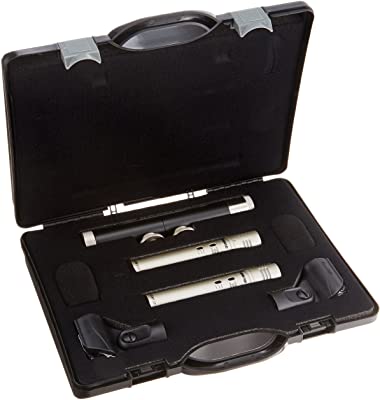
It would be criminal to go make a list of drum mics and not mention anything from Shure. So, the Shure mics of choice today are the KSM137s. These mics are small-diaphragm cardioid condensers that have a small structure along with a few knobs and whistles that can be very useful when tracking drums.
The gold-plated Mylar diaphragms allow for great transient response which is great for drum kit applications. The mics also have transformerless preamplifiers which make drum recording sound extremely natural and transparent.
The mics have 3-position pads along with 3-position highpass filters that give you many options to choose from when recording. This makes them extremely versatile. They have an staggeringly wide dynamic range, meaning they will work excellently for all kinds of drum kit setups.
There’ll be crisp and clean high-end with virtually no distortion to go with it. Overall, they’re a great choice for overhead mics that will last a long time and bring a great tone out of your drums.
The carry case that is included is very sleek and easy to transport around.
Something unique that I saw with these mics is that they handle low frequencies surprisingly well. If you put one near the bass drum, you’ll get a sound that strongly rivals the sound a dedicated bass drum mic would produce.
So, if these are the only mics you can get, you could position them in a way that would pick the depth of the bass drum up as well as the entire drum kit. I wouldn’t say that it’s the most ideal setup in the world, but it would work quite well.
PROS
CONS
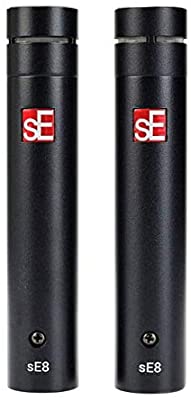
Two things come to mind when thinking of the sE8s from sE Electronics -quickness and value-for-money. These small-diaphragm condenser microphones produce a great tone that is fairly uncommon from mics in their price range. Along with that is the extremely quick responsiveness.
These mics capture the drum kit with an amazing amount of nuance. They make your cymbals sound extremely good, no matter how high-quality the cymbals are. That’s one of the great things about drum microphones which is extra-true for these ones.
They have 80Hz and 160Hz highpass filters along with 10dB and 20dB pads, making them very versatile in the types of sounds they can pickup.
If you have a giant 7-piece kit with 11 cymbals, these mics will have no problem picking up the array of tones from all the drum parts. The same can be said for a minimalist 3-piece setup.
The compact design also makes them fairly easy to position around the drums. Another bonus to these mics is that you could very easily use one of them as a hi-hat mic and it would pickup the crispness beautifully.
They’re a fantastic mid-range set of overheads that are high in value and relatively low in cost compared to the value they bring.
While I think having larger mics would bring more sound out of your kit, the benefit of smaller mics is that you can position them easier. These sE8s are some of the smallest high-quality mics on this list, making them incredibly useful mics to have if you’re limited for space.
You may not think having space above a drum set would be an issue, but I’ve played a few gigs where the overhead mics wouldn’t fit because their bodies were too large. This was mainly due to the fact that there was a drum shield, but mics like the sE8s would be the perfect solution for that situation.
PROS
CONS
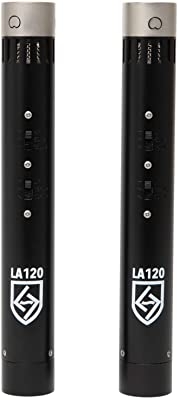
These Lauten Audio LA120 microphones are packed with features so get ready for some information. Firstly, they have interchangeable pressure-gradient capsules.
This means you can change the pickup patterns from cardioid to omnidirectional, giving you several choices for mic’ing drums and making these mics extremely versatile.
Next on the list, they have lowpass and highpass filters, further adding to their versatility. These filters along with the interchangeable pickup patterns make the LA120 mics great for using in recording studios as well as live gigging situations.
Some mics are good for certain situations. These are great for every situation.
You can engage the lowpass to roll off those piercing highs from cymbals, making them sound less intense. You can also set the mics to have a flat response that is easy to mix from. Whatever you need, these mics will probably be able to do it.
They have a cool wooden case that is included with the purchase. This wooden case is a great extremely durable and protective, meaning your mics won’t be damaged when travelling. It also looks great when placed in a microphone locker in a studio.
There are some other mics at this price-point that tend to sound better. However, these are some of the most versatile mics in the category.
If you plan on building a microphone locker, I highly suggest you get a set of these. They have so many features packed into them that they would undoubtedly be useful at some point in your music recording journey.
I’m amazed at how good they are for most instruments, not just drums. I think they’d be a very valuable upgrade from entry-level condenser mics.
PROS
CONS
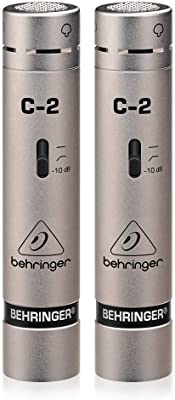
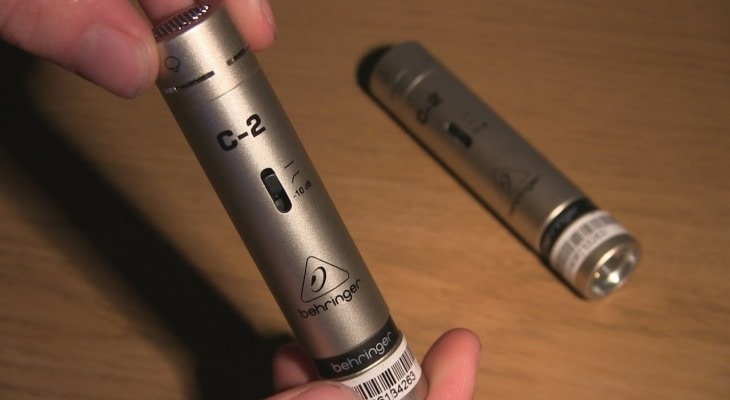
Next on the list is a set of extremely affordable overhead mics. Although Behringer has some high-quality products, they seem to thrive the most in the entry-level affordable product sector.
These C-2 mics are a great option for anyone that is new to the world of drum tracking and needs some cheap mics to get started.
They’re small diaphragm condenser mics with a cardioid pattern. The first thing you’ll notice is that they’re extremely small. In fact, they’re the smallest microphones on this list. This makes them easy to position. It also makes them very light to carry around.
The raw sound you get from these mics is obviously not as great as it would be from some higher-priced mics. However, there’s potential to get a really good sound with some mixing practice and experience.
This is why they’re such a great mic for beginners. They’re cheap and they’ll force you to improve your EQing skills as you go along. You may need to have really good preamps if you want to use these professionally, but that’s a topic for another day.
Overall, these would be great options for intermediate or advanced players. There are better mics out there. They’re best suited for beginners and anyone on a seriously tight budget.
I love how these mics aren’t harsh like other cheap mics are. The harsh sound is something that has always chased me away from buying budget microphones. Somehow, Behringer has been able to keep the harshness away, allowing these mics to produce a clear sound that will pick up most of your drum kit.
A downside of these mics is that they don’t interact too well with changing gain levels. I found that if you had a sound source that changed or moved somehow, you’d need to do a fair bit of readjusting to get a good level again. This makes the mics a bit of a mission to use in recording environments.
PROS
CONS
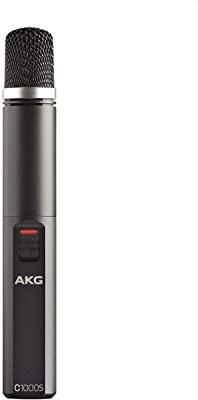
Although it’s common to use a matched pair of microphones as overhead mics, you don’t always need to use two of them. Some situations will only need one overhead.
This could be due to space limitations or just having a small drum kit that doesn’t need to many mics. The AKG C1000 MK4 is a great option for these situations.
This mic has a small diaphragm along with a cardioid pattern. It also has a hypercardioid adapter, presence boost adapter, a -10dB pad, and a highpass filter. The icing on top of all these features is the fact that you have the option of using batteries for mobile use.
This mic will render your drum kit with crystal clarity, sounding smooth across medium and high frequency ranges. The batteries can be used instead of phantom power, making the mic a useful option for playing gigs where phantom power may not be available.
Unfortunately, the mic lacks power in the lower ranges, meaning you’ll need to use a kick drum mic to bring out the full character of the kick drum.
Overall, it’s a fantastic option if you’re looking for just one overhead. It comes in at a relatively affordable price point considering all the features it has.
My one gripe with this mic is that it’s a bit bulky. It’s perfectly fine for setting up at your drum kit, but it can be somewhat cumbersome when traveling around with it. It comes with a bag to hold it in but having it in the bag along with the mount makes it even heavier to carry. I wouldn’t suggest using two of these purely due to the size of the mic.
The fact that you can use a battery instead of phantom power makes me want to put this mic in my collection to use as a backup for whenever the need arises. I think that’s the most useful feature of the mic.
PROS
CONS
How to Place Overhead Mics for Drums
One vital aspect of recording drums is placing the microphones in the right places. This can make or break your drum mix, so it’s important to place them properly.
When it comes to overhead microphones, you need to place them so that they can pickup the entirety of your kit. This is generally why people will use a matched pair for stereo recording. Using just one may not allow you to get a complete sound.
The two microphones need to be evenly spaced from each other. You also need to place them in a way that won’t allow you to accidentally hit them when you’re playing. You just spend a bunch of money on them, so you need to be careful not to whack them with drum sticks.
Choosing a Microphone Brand
Similar to drums and cymbals, there are so many high-quality microphone brands to choose from. You get brands like Earthworks that are known for producing immaculate mics that come at hefty prices. Then you get brands like Behringer that are most popular for producing budget mics.
You could choose one of those or go with anything in between. My best piece of advice would be to try different mics out and see which brands you gel with the most.
It’s okay to mix and match mic brands around the kit. However, I wouldn’t suggest mixing two different brands of overhead mics together. Overhead mics work in unity, so it’s always better to have a matched pair.
Factoring Cost
The cost of microphones confused me for the longest time. Some microphones will cost well over $1000 while others can be picked up for less than $100. I used to think that they all did the same job, so I didn’t understand why the price difference was so massive.
The thing about expensive mics is that they make it easier to get a good sound. You’re not going to get a pro-level drum recording with cheap mics if you’re not a pro-level sound engineer. So, it’s worth it to invest in high-quality microphones.
However, many of the sound qualities that more expensive mics produce will be totally missed by people who aren’t experienced in sound engineering. You could get an expensive mic and not really hear the difference between that and a cheaper mic.
So, I think it’s a good and balanced decision to get a set of drum overheads that fall somewhere in between. That’s only if you’re not on a budget.
How to Record Drums
If you want to record drums at home with the use of microphones, you need to have an interface and a DAW. The interface is what connects the microphones to a computer and the DAW is the software that you use to mix and EQ the sounds.
Some popular DAWs would be GarageBand, Logic Pro X, Reaper, and ProTools. Every DAW does mostly the same things. Ultimately, it all comes down to personal preference.
Recording and mixing drums is a skill that takes years to get good at. No one became a professional studio producer overnight. So, don’t get too frustrated if your drum recordings don’t sound that great to begin with.
Conclusion
Remember that you’re going to need an interface and some software before getting a set of overhead microphones. Once you have those things, you can choose a pair of mics that you think will fit you the best.
There are so many options out there, these are just some options that tend to work best for drummers.
Every microphone company offers some great products. You need to decide which product is best for you and then run with it. Most studio producers have multiple microphones for different uses.
There never is a one-size-fits-all when it comes to these things. So, choose your mics carefully and get recording!
